
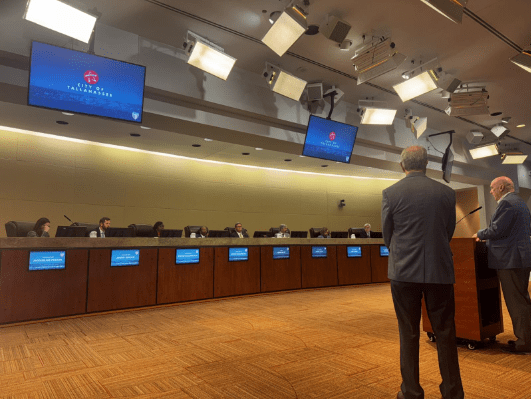
In a 3-2 vote on Jan. 14, the City Commission cleared the way for the city manager to negotiate the sale of Tallahassee Memorial Hospital to Florida State University, a move that would transfer ownership of the city-run hospital to FSU.
The goal of the proposed sale is to create a major academic medical center, transforming the hospital into FSU Health. Supporters say the move could expand medical education and research, attract nationally recognized physicians and develop new specialties such as cancer, heart and neurological care, while also stimulating economic growth.
The decision, however, drew significant concern from commissioners and residents who questioned the hospital’s assessed value and the long-term impact on public control and patient care.
Several residents urged commissioners to delay the decision, citing unanswered questions about the deal.
“This is not just a business decision. This is a moral decision,” Dr. Bruce Strouble states, calling on the commission to slow the process and ensure protections for vulnerable communities.
City Commissioner Jeremy Matlow, who voted against the motion, said public frustration stems from how the city is handling what he describes as a valuable public asset. He raised concerns about the proposed $109 million payment from FSU over 30 years, saying it is far below the hospital’s market value.
“That’s drastically low for what property owned by the city of Tallahassee is worth,” Matlow said, adding he hoped appraisals would place the value between $250 million and $500 million.
While Matlow said an academic affiliation could benefit the hospital, he argued the current deal raises concerns about transparency and fairness.
City Commissioner Jack Porter also questioned how the hospital’s value was calculated, asking why the benefit Tallahassee Memorial Hospital has provided to the community was deducted from the proposed sale price.
City Manager Reese Goad said the adjustment reflects the hospital’s long-standing lease arrangement, noting that TMH has not been paying rent and that it’s not a tangible asset the city can sell, but rather a lease.
Matlow proposed a substitute motion to delay negotiations until two appraisals could determine the hospital’s market value. Commissioner Jack Porter seconded the motion, but it failed oin a 3-2 vote, with Mayor John Dailey, Commissioner Curits Richardson, and Commissioner Dianne Williams-Cox voting against it.
Tallahassee Memorial Hospital CEO Mark O’Bryant said serving a larger population and forming academic partnerships are key to expanding medical programs and specialized care. He said academic medical centers help establish a reputation that attracts nationally recognized specialists and draws patients from across the region.
“Academic centers are differentiators,” O’Bryant said, adding that building the right reputation could bring patients from cities such as Pensacola, Mobile, and Jacksonville in search of specialized care.
Concerns were also raised about reproductive rights and potential discrimination under university ownership. When asked how such issues would be addressed, FSU President Richard McCullough said similar fears have not materialized at other state overseen hospitals.
“I understand the fear of the people,” McCullough said. “But the reality is that’s just not happening.”
Commissioners who supported the motion emphasized the long-term benefits of the sale. Commissioner Dianne Williams-Cox said the discussion has been ongoing for nearly a year.
“This is not going to happen overnight; it’s an evolution, but you’ve got to start somewhere,” she said.
Commissioner Curtis Richardson called the decision “transformative” for Tallahassee and Leon County, and Mayor John Dailey said he was in full support.
The city manager will now begin negotiating the terms of the sale with FSU. A final agreement is expected to return to the City Commission in March for approval.
 ajawaseem.com